Authorize the exact strategy
Live authorization is tied to a strategy release and your connected account. A paper result or a plan purchase alone does not authorize real orders.
Live trading
AI agents build and review strategies. You authorize the specific strategy and exchange account for live trading, while the execution system checks permissions, risk and account readiness before acting.
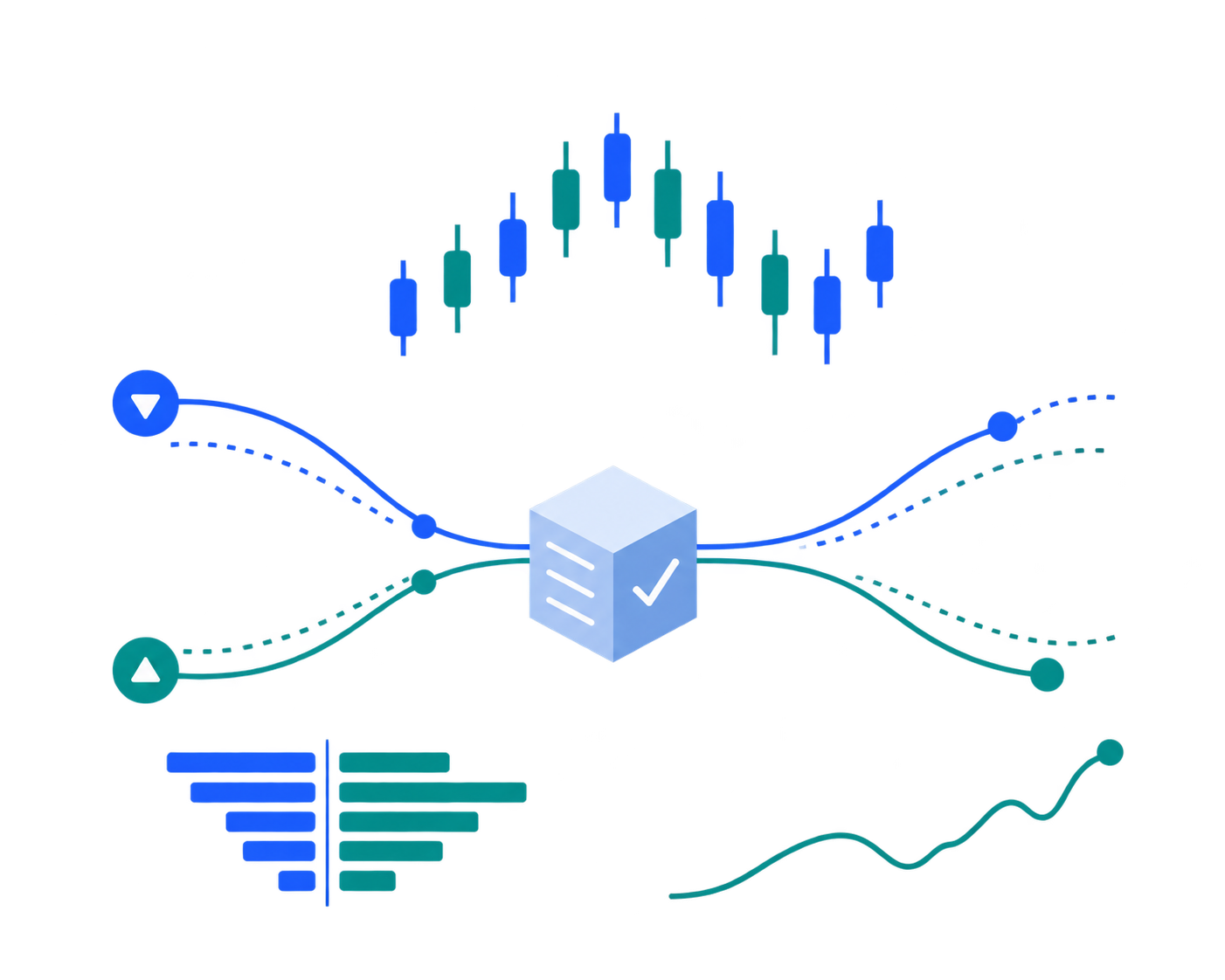
Interactive illustration
An approved strategy can request exposure before the exchange fills it. Replay an illustrative order sequence to compare the target with the filled position.
Partial fills and delays leave exposure different from the request. The Live Trading workspace records orders, positions and reconciliation evidence so you can investigate that difference.
Position (illustrative units)
Execution checkpoint
An order request can precede its first fill.
Partial fills change the position in separate steps.
A reduced target still needs confirmed execution and reconciliation.
Explore how this stage contributes to the AI trading strategy factory.
Live authorization is tied to a strategy release and your connected account. A paper result or a plan purchase alone does not authorize real orders.
The live executor follows eligible paper-strategy intents, checking freshness, duplicate submissions, account permissions and pre-trade risk.
Review orders, positions, account equity and reconciliation alongside the control audit log. The account’s readiness determines which actions are available.
The live path combines a reviewed strategy with an explicitly authorized account. Supported venue and account capabilities determine whether execution can proceed.
Start from the admitted strategy artifact.
Approve the strategy for a specific connected account.
Check readiness, permissions and risk before submitting.
Compare recorded orders and positions with the exchange.
Use the live trading workspace to inspect account readiness and the outcome of every control action. An instruction is not the same as an exchange-confirmed result.
Scroll horizontally to see all columns.
| Control | Purpose | Follow-up |
|---|---|---|
| Authorize / revoke | Grant or remove live permission for a strategy and account. | Inspect the matching release and authorization record. |
| Arm / resume | Permit eligible execution after readiness checks. | Confirm the account and current operational status. |
| Halt | Stop new entries through the trading gate. | Review existing positions; halting is not flattening. |
| Flatten | Request position reduction or closure where supported. | Check exchange confirmations, remaining exposure and reconciliation. |
No. You need a supported connected account, the required verification and readiness checks, a matching strategy release and explicit live authorization. Availability varies by venue and account.
No. AI agents develop and review the strategy. A human authorizes the live strategy and account, and enforced controls govern execution.
No. Live market pages let you browse market data. Live trading is the signed-in workspace for authorized exchange execution and account monitoring.
No. Halting blocks new entries. Closing exposure is a separate action; inspect position state and exchange confirmations after requesting it.
Live permission is tied to a specific release artifact. A revised strategy must satisfy the applicable release and authorization requirements before it is eligible for live execution.
Real execution introduces actual liquidity, latency, partial fills, costs and exchange constraints. Compare the records and investigate differences rather than treating paper results as a live forecast.
See how AI agents, testing engines and execution controls work together across the strategy factory.
Stratmill is an AI trading strategy platform, not financial advice or a broker. Backtest and paper results are hypothetical. Trading involves risk of loss.