Sensitivity
Inspect how nearby parameter settings change results. A sharp performance drop deserves investigation; a stable region is useful evidence, not proof.
Your research workspace
Compare parameter sensitivity, walk-forward results and holdout evidence. Inspect confidence and trade counts alongside performance.
Inspect how nearby parameter settings change results. A sharp performance drop deserves investigation; a stable region is useful evidence, not proof.
Read the training and evaluation dates, trades and results for each window. Short histories and sparse trading can leave too little evidence for a confident conclusion.
Inspect the reserved-period result separately from the optimization fit. Repeated changes after seeing test results can weaken their independence.
Data availability, instrument history, fees and fill assumptions vary by venue. Review the coverage and assumptions recorded for your run.
Explore market dataBacktests simulate the past. Paper trading adds forward observations. Low-confidence results are not statistically proven, and neither is a promise of returns.
Explore paper tradingOpening a workspace, importing code or starting a backtest does not authorize real-money orders. Live execution requires your approval and a supported connected account.
Explore live tradingInside the product
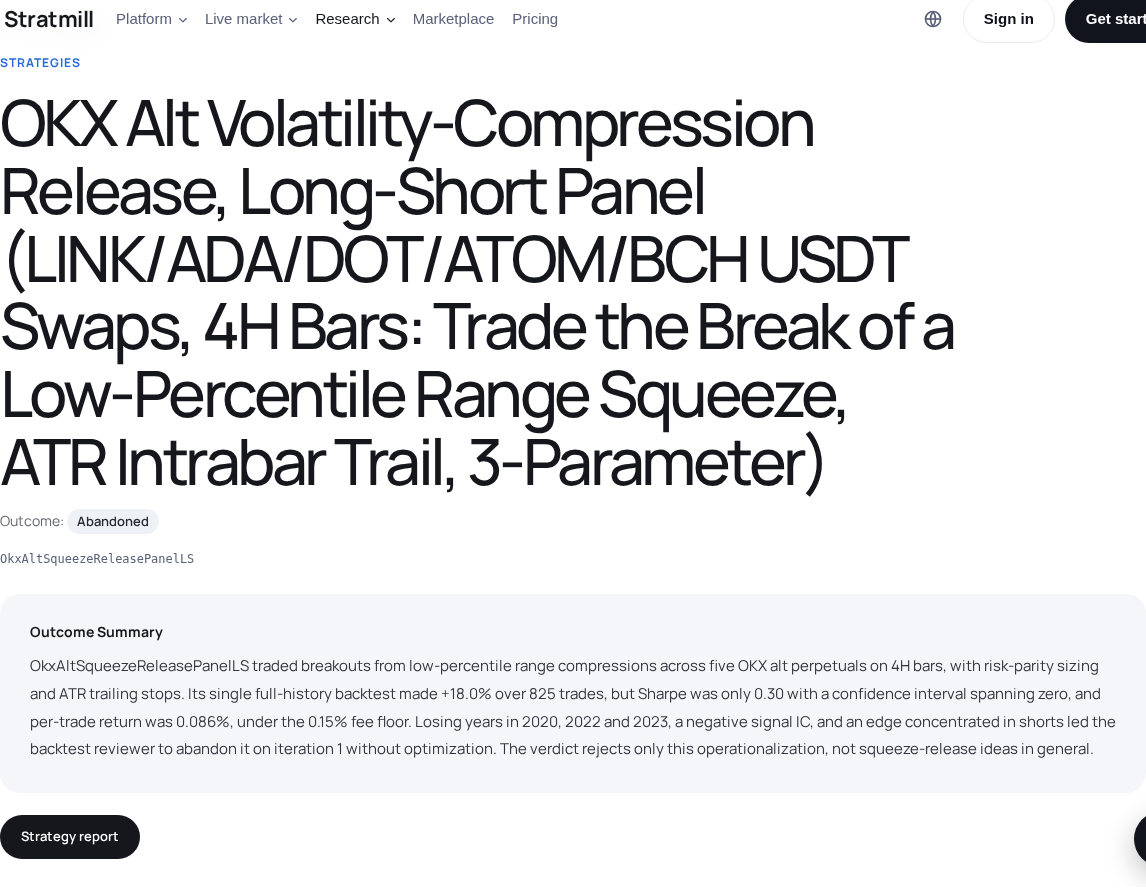
This public strategy was rejected after review. Inspect its hypothesis and recorded findings to see why a positive headline return is not enough.
Read the public report